

 ع
ع



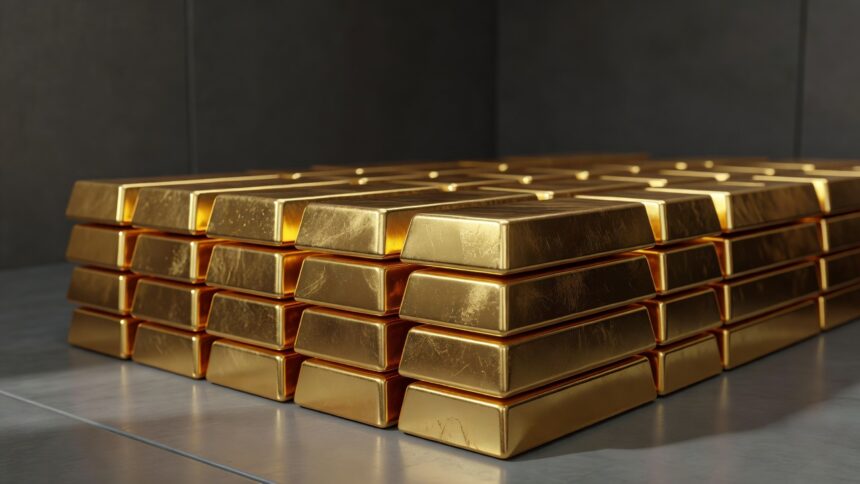
The Emirates News Agency (WAM) reported that gold prices rose to a seven-week high on August 6, 2026, extending gains for a fourth consecutive session as the US dollar came under pressure and the yield on the benchmark 10-year Treasury note declined. Spot gold traded at $4,289.00 per ounce, its highest level since June 18, while US gold futures stood at $4,345.50 per ounce. The combination of currency weakness and lower yields boosted the metal’s appeal to holders of other currencies, according to the agency’s market update.
WAM listed prices for other precious metals on the same day, with silver trading at $62.34 per ounce, platinum at $1,750.15 and palladium at $1,377.00. Trading Economics figures show gold rose 0.52 percent to around $4,269 per ounce that day, having advanced 3.98 percent over the past month and 25.74 percent from the same period a year earlier. The data service places the metal’s all-time high at $5,608.35, reached in January 2026.
A JPMorgan Global Research assessment found that gold prices have displayed considerable volatility throughout 2026, with an early peak in late January followed by a cooldown and a floor near $4,170 per ounce before the latest recovery. Bank analysts expect the metal to average $6,000 per ounce by the final quarter of 2026 before climbing toward $6,300 by the end of 2027. Trade concerns, geopolitical developments and sustained central bank activity have shaped these movements, the assessment noted.
State Street Global Advisors projected in its 2026 outlook that gold would likely consolidate between $4,000 and $4,500 for much of the year, underpinned by anticipated Federal Reserve easing that lowers the opportunity cost of holding non-yielding assets. The investment manager observed that policy rate cuts tend to weaken the dollar by narrowing interest-rate differentials, creating a favorable environment for gold as seen in earlier periods of monetary accommodation. Such conditions have reinforced the metal’s role as a store of value amid fiscal and liquidity shifts.
Market observers have tied the latest advance to softer US labor market readings and reduced geopolitical strains that have reinforced bets on a less aggressive monetary policy stance from the Federal Reserve. These elements have helped gold recover from intra-year dips while investors monitor forthcoming economic data for further direction on rates. The metal’s performance continues to reflect its sensitivity to currency fluctuations and real-yield dynamics across global markets.