 ع
ع


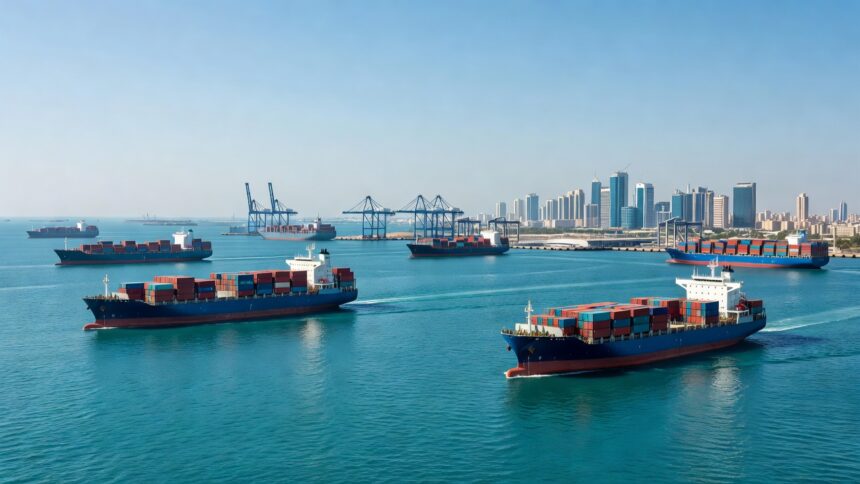
BlackRock senior managing director Mike Pyle described the Gulf as the linchpin of a key corridor connecting the region with South Asia and South-East Asia at a panel on Middle East economies during the International Monetary Fund and World Bank Spring Meetings. Pyle told the audience that this stretch ranks among the most dynamic parts of the global economy, driven by deepening ties in trade, energy and investment flows. He added that no other segment of the world economy shows comparable momentum, according to a report by The National.
Trade between the Gulf and Asia has expanded sharply over the past decade to reach about $516 billion annually. An Asia House analysis found that Gulf-Emerging Asia trade rose 14.4 per cent in 2024 to that level despite softer oil prices, propelled by both hydrocarbon demand and growing non-oil exchanges. China, India and Japan together account for roughly 36 per cent of overall Gulf trade, while bilateral flows with India stood at $178.6 billion in fiscal 2024-2025 and those with ASEAN members totalled $130.7 billion in 2023, The National reported citing the panel.
IMF deputy managing director Bo Li noted that the conflict involving Iran could reshape certain economic relationships but maintained that core links between the Gulf and Asia would persist. Refinery configurations in China, India, Japan and South Korea remain oriented toward Gulf crude, making adjustments difficult, while long-term LNG contracts continue to anchor bilateral energy commerce, Bo Li explained. He said nations would pursue diversification of suppliers, shipping routes, energy mixes and strategic reserves, yet the underlying interdependence between the two regions would not diminish.
Pyle acknowledged short-term economic pressures on GCC states from disruptions to energy flows but forecast an investment-driven response over the medium term. International Energy Agency chief energy economist Tim Gould pointed out that, unlike oil, few alternative routes exist for LNG shipments, underscoring vulnerabilities in gas trade. The panel highlighted how economic ties now extend well beyond hydrocarbons into areas such as fertilisers, logistics and infrastructure projects.
Gulf economies have accelerated diversification beyond their energy base into financial services, tourism, technology and artificial intelligence, Pyle stated. UAE-China non-oil trade reached $90 billion in 2024 and grew more than 15 per cent year on year in the first half of 2025, while Saudi non-oil exports rose more than 20 per cent over the same period, The National reported. These shifts illustrate how non-oil commerce now plays an expanding role in regional integration.
A World Bank Gulf Economic Update documented significant variation across GCC external sectors, with many countries sustaining robust export connections to Asian partners as of 2023 data. IMF regional outlooks project that, despite near-term headwinds from geopolitical tensions that have curtailed maritime traffic through key chokepoints, the established trade architecture supports longer-term resilience. Panellists agreed that the Gulf’s position as a connector between Asia, South Asia and South-East Asia remains firmly in place.