ع




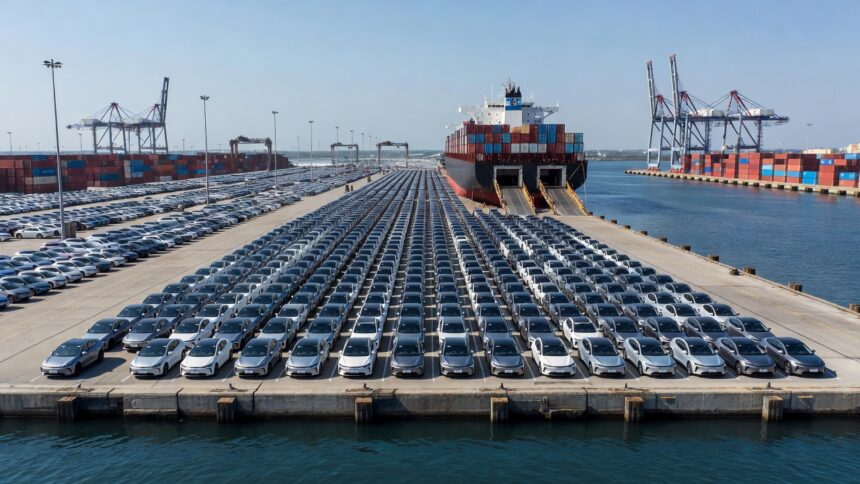
Qatar National Bank highlighted China’s electric vehicle export success in its latest weekly economic commentary. New energy vehicle exports reached 2.62 million units in 2025, doubling from a year earlier, according to the bank. Battery-electric models accounted for 1.65 million units with a two-thirds increase while plug-in hybrid exports more than tripled. This expansion elevated total vehicle exports beyond 7 million units, positioning China as the clear global leader in auto exports.
The bank reported that the trend extended into 2026 with first-quarter NEV shipments approaching 1 million units and representing over 40 percent of all vehicle exports. Exports have emerged as the primary growth engine for the automotive industry. Domestic sales declined nearly 25 percent in early 2026 after purchase tax incentives were reduced to an effective 5 percent rate from full exemptions.
In its 15th Five-Year Plan covering 2026 through 2030, Chinese authorities removed new energy vehicles from the strategic emerging industries list for the first time in 15 years. Qatar National Bank interpreted this as a sign the sector is now mature and should be guided more by market dynamics than subsidies. The plan instead prioritizes technologies such as quantum computing, hydrogen and advanced manufacturing while setting goals to roughly double charging infrastructure and better integrate vehicles into the power grid by 2030.
QNB noted that more than 100 brands compete in the domestic market where factory utilization averages around 60 percent and profit margins have dropped to approximately 3 percent. These factors have exacerbated deflationary pressures throughout the economy. A Reuters report indicated Chinese EV exports generated almost 70 billion dollars in 2025 and reached more than 150 countries and territories.
The commentary described the implications as double-edged for the wider economy. On one side the industry supports a record trade surplus and demonstrates technological capabilities. On the other heavy export reliance invites trade barriers that have prompted some producers to establish manufacturing overseas.
China Association of Automobile Manufacturers figures placed new energy vehicle production above 16 million units during 2025. A South China Morning Post analysis projected substantial consolidation with only 15 to 20 companies likely to remain viable by 2030. The QNB commentary concluded that the sector’s path forward would be shaped by its ability to compete internationally and consolidate domestically as authorities focus on curbing overcapacity.