 ع
ع


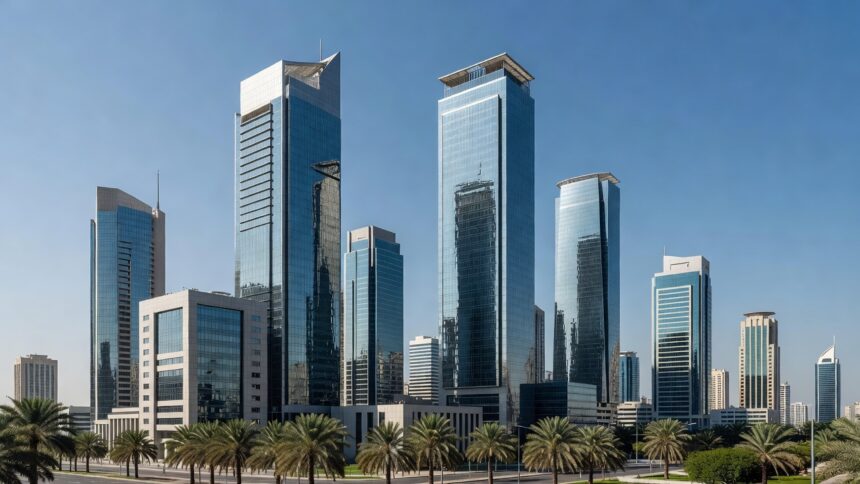
Kuwait Financial Centre Markaz reported that the Kuwait All Share Index climbed 5.3 percent in April 2026 while the banking sector index increased by 3.1 percent. Banking stocks showed mixed results with National Bank of Kuwait falling 1.5 percent month-on-month even as Gulf Bank and Kuwait Finance House advanced 8.2 percent and 5.0 percent respectively on the back of strong first-quarter earnings. Premier market leaders Aayan Leasing and Investment Company and Mabanee Company posted the largest gains of 19.2 percent and 17.3 percent with the former’s real estate subsidiary signing a 15-year agreement to develop a property expected to generate KD 336,000 annually.
The investment firm’s analysis showed real estate sales across Kuwait dropped 31 percent quarter-on-quarter in the first three months of 2026 amid March’s geopolitical escalation. Residential transactions declined 33 percent to KD 396 million from KD 591 million in the fourth quarter of 2025. Commercial and investment sales similarly fell 21 percent and 33 percent respectively as uncertainty gripped the sector.
According to Markaz all GCC equity indices closed April in positive territory except for Saudi Arabia with Dubai’s DFM index leading at a 6.1 percent gain and the S&P GCC Composite index rising 1.1 percent overall. The temporary ceasefire and reopening of the Strait of Hormuz provided the main support for regional bourses while UAE real estate shares rebounded with Emaar Development climbing 8.0 percent. Qatar Oman and Bahrain posted respective increases of 2.9 percent 2.5 percent and 3.8 percent.
Fitch Ratings assessed that GCC economies demonstrated resilience to the regional tensions that escalated in March 2026 thanks to strong fiscal buffers sovereign wealth and policy tools. Prolonged conflict could pressure growth fiscal balances trade and tourism particularly for less buffered sovereigns. In response governments rolled out measures such as liquidity support SME financing and wage subsidies.
Global benchmarks delivered solid returns in the month with the MSCI World Index up 9.4 percent and the S&P 500 advancing 10.4 percent as easing U.S.-Iran tensions and robust corporate results lifted sentiment. The Nasdaq Composite surged 15.6 percent on artificial intelligence driven earnings while the MSCI Emerging Markets index gained 15.8 percent led by technology heavyweights. South Korea and Taiwan led country performances with rises of 30.6 percent and 22.7 percent.
Brent crude fell 3.7 percent to settle at $114 per barrel although prices swung wildly reaching an intraday peak of $126 on April 30 before the ceasefire talks stalled. The yield on 10-year U.S. Treasuries rose 10 basis points to 4.40 percent amid inflation worries tied to elevated energy costs. The United Arab Emirates’ departure from OPEC refocused attention on bloc dynamics and potential for higher output from the emirate’s reserves.
The International Monetary Fund’s April 2026 World Economic Outlook held global growth projections steady at 3.1 percent for the year while cutting the GCC forecast by 2.3 percentage points to 2.0 percent citing inflationary pressures and trade interruptions from the conflict. A separate IMF data mapper placed Kuwait’s 2026 real GDP growth at minus 0.6 percent following the revisions. Markaz concluded that geopolitical developments in the Middle East will continue to dictate market direction into May with investors watching for signs of lasting de-escalation.