
 ع
ع



e& UAE said in a statement that it had become the first telecom operator globally to successfully test enhanced Reduced Capability on its live commercial network. The development demonstrates a practical pathway for enterprises and public-sector organisations to move widely deployed IoT applications from legacy LTE technologies onto a simpler and more energy-efficient 5G-native IoT platform. Abdulrahman Al Humaidan, senior vice president for access network development at e& UAE, said, “The value of eRedCap is the ability to bring practical, everyday IoT applications into the 5G era at the right cost, power profile and coverage. By proving this capability on our live commercial network, e& UAE is giving utilities, manufacturers, logistics providers, smart-city operators and other sectors a credible path to scale connected devices and prepare for the industry’s long-term transition beyond LTE.”
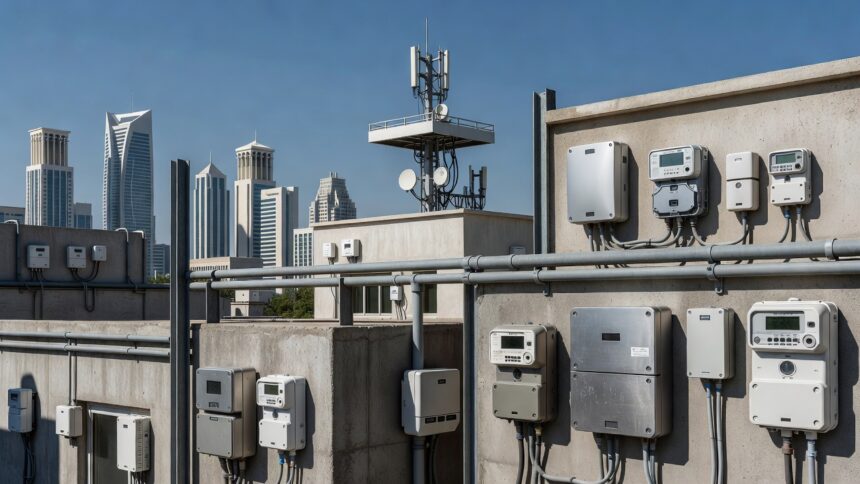
The statement noted that eRedCap is designed to support a large number of connected devices that do not require the full performance capabilities of 5G. Suitable uses include smart utility meters, industrial sensors and controllers, asset and fleet tracking, payment terminals, building-management systems, security devices and selected wearables. It provides the coverage, battery life and cost profile needed for large-scale deployments while offering a future-ready route into the 5G-Advanced ecosystem. For the industry, the technology can reduce network and device fragmentation while helping to simplify deployment, lower complexity and improve scalability across IoT ecosystems.
Enterprises can consolidate more IoT use cases on 5G Standalone rather than maintaining separate technology paths for high-performance 5G and LTE-based IoT, according to the statement. This approach can simplify device lifecycle management, strengthen security and service assurance, and support the long-term refarming of LTE spectrum without requiring every application to use full-capability 5G hardware. The statement added that eRedCap builds on RedCap power-saving features to enable a more sustainable environment with massive IoT connectivity and extended battery life. Battery life for an IoT device improves from one to three years with standard RedCap to five to 10 years with eRedCap, comparable to Low-Power Wide-Area technologies, while matching LTE Cat-1 and Cat-1bis in cost, coverage and battery performance.
e& UAE reported that the live commercial test demonstrated throughput speeds of up to 10 megabits per second on low-capability devices utilising a 5 megahertz narrow bandwidth of NR-FDD spectrum. A Data Transmission Unit was integrated into the live commercial network to verify the eRedCap services. The milestone reinforces the operator’s position in translating 5G-Advanced standards into commercially relevant capabilities for the UAE’s digital economy. The test follows the company’s launch of standard Reduced Capability technology in September 2025, which activated a smartwatch as the first live use case in the UAE, according to its earlier announcement, and builds on a 2024 collaboration with Ericsson to complete the first 5G Standalone RedCap implementation in the Middle East and Africa.
Ericsson’s Mobility Report forecasts that cellular IoT connections will achieve a compound annual growth rate of around 11 percent through 2030, surpassing 7 billion by that time. The report states that eRedCap, introduced with 3GPP Release 18, is designed for use cases currently served by LTE Cat-1 and Cat-1bis technologies, creating a substantial growth opportunity by broadening the addressable market for 5G IoT devices. GSMA Intelligence projections place broadband and critical IoT connections at 4.3 billion by 2030, with RedCap and eRedCap expected to account for a significant share of cellular IoT growth as legacy 2G and 3G networks sunset. MarketsandMarkets data shows the 5G IoT market expanding from 13.2 billion dollars in 2023 to an estimated 59.7 billion dollars by 2028 at a compound annual growth rate of 35.1 percent.