ع




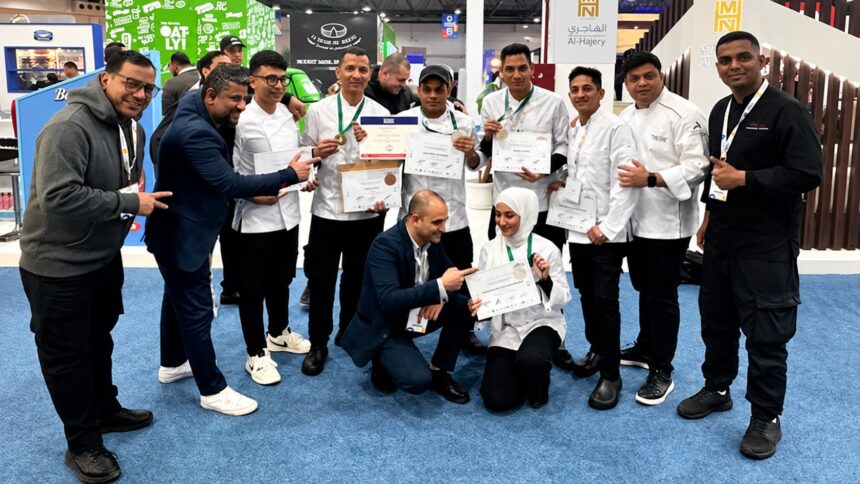
Culinary competitions make the trade show visible, while food waste, equipment choices and staff skills reveal the industry’s less glamorous operating questions.
The most visible part of a hospitality exhibition is often the food. Behind it sit less photogenic questions: how ingredients are bought, how much is discarded, which equipment a kitchen needs and how staff maintain consistency during a busy service. Those decisions shape the economics of a restaurant long after an exhibition closes.
HORECA Kuwait provides a setting in which the two sides of the industry meet. The event combines suppliers and professional equipment with culinary competitions and discussion. Its organisers, Leaders Group and Hospitality Services, have listed the next edition for 12–14 April 2027 on the Hospitality Services event page.
With the next cycle ahead, a useful question is how the skills celebrated on a competition stage relate to the less visible work of running a kitchen. Food waste offers one concrete starting point, connecting purchasing, preparation, portion sizes and the use of staff time.
Culinary skill is only part of the operation
Kuwait’s 2026 edition generated specific evidence of professional participation. In a January announcement, Alshaya Group said 39 of its chefs had taken part and received 21 awards, comprising ten silver and eleven bronze medals. Its participating teams represented several restaurant brands and different culinary disciplines.
Those results describe a company’s performance in the competition. They do not measure the profitability of its restaurants or the performance of Kuwait’s hospitality sector as a whole. They do, however, identify real staff and practical skills within an event that can otherwise be described only through exhibitor totals.
The distinction between competition and daily service is important. A judged dish is prepared within the requirements of a particular category. A working kitchen must reproduce its menu across shifts, manage stock and respond to changing demand. Both require technical competence, but the operating conditions are different.
Coverage that follows the chefs back into those conditions can explain more than a medal count. It can examine how a technique is taught, how recipes are standardised and how an operation decides whether a change is practical across a larger team.
Waste is an operating issue, not just a bin
The UN Environment Programme’s Food Waste Index Report 2024 estimated that 1.05 billion tonnes of food were wasted across households, food service and retail in 2022. Food service accounted for approximately 28% of that global total.
The figure is not a measurement of Kuwait’s hotels and restaurants. It establishes the scale of the international issue and the importance of looking at food service separately from household waste. It also shows why a hospitality exhibition is a relevant place for the subject, rather than an unrelated environmental addition to the programme.
Food discarded after purchase has already passed through part of an operating system. It may have been transported, refrigerated, prepared or served. The financial cost is therefore not always captured by the purchase price of the ingredient alone. Labour and other resources can be involved before the food reaches a waste container.
Identifying the point at which waste occurs changes the possible response. Over-ordering is different from preparation loss, and both differ from food left on a customer’s plate. Treating them as one undifferentiated total makes it harder to understand what has happened in a particular kitchen.
Measurement comes before a savings claim
UNEP’s work on reducing food loss and waste places measurement within a wider effort to reduce waste across food systems. For a restaurant or hotel, the relevant information needs to be specific enough to connect a problem with the way the operation functions.
A supplier may offer storage equipment, portioning tools or a digital system. None automatically establishes a saving for every buyer. The result depends on the starting conditions, how the product is used and which outcome is measured. A percentage quoted without that context is difficult to interpret.
The useful discussion at a trade exhibition therefore concerns evidence. An operator can ask how a result was calculated, over what period and in what type of kitchen. A demonstration can explain how equipment works, while a measured case study addresses what happened after installation.
This gives procurement a different emphasis from simply finding the newest product. Kitchens need to understand capacity, cleaning, maintenance and the ability of staff to use a system consistently. Those requirements determine whether an attractive demonstration translates into a workable change.
The exhibition floor connects the decisions
HORECA’s published industry programme brings food and beverage suppliers together with equipment, technology and operational services. That breadth reflects the number of decisions required to deliver even a relatively short menu. A change in one area can affect another.
A different ingredient, for example, can change preparation time or storage needs. A new machine can alter capacity while introducing maintenance requirements. These are analytical examples of how kitchen decisions interact, not claims about a particular exhibitor’s results or an announced change at a Kuwaiti restaurant.
The next edition’s date is the organiser’s currently published plan. Trade directories carry other dates, making the organiser’s own updates the relevant reference as the programme develops. Confirmed exhibitors and final competition details will add substance to the calendar listing.
For Kuwait’s hospitality industry, the strongest story is the connection between professional skill and daily operation. A well-executed dish is visible immediately. Better purchasing, clearer measurement and less avoidable waste are established through what happens repeatedly in the kitchen. An exhibition becomes more informative when it makes both kinds of work visible.