 ع
ع


Kuwait Financial Centre’s Real Estate Outlook for the first half of 2026 projected continued growth across key GCC markets, with higher oil production, expansion in the non-oil economy, infrastructure spending and anticipated policy rate cuts expected to boost liquidity, credit and investment activity. The Markaz assessment, released in February, examined residential, commercial and industrial segments in Kuwait, Saudi Arabia and the UAE, where strong performance in late 2025 provided the foundation for further advances. A separate projection from Market Data Forecast placed the broader Middle East real estate market at $865.90 billion in 2025, on track to reach $937.85 billion this year at a compound annual growth rate of 8.31 percent through 2034.
Markaz’s analysis found Kuwait’s real estate sector recorded stable expansion through the first nine months of 2025, with land prices rising across governorates and rental rates advancing in the investment segment. Total real estate sales climbed 26.9 percent year on year to KD3.04 billion, led by a 60 percent jump in investment segment transactions while residential and commercial sales gained 8 percent and 17.4 percent respectively. National Bank of Kuwait data later placed full-year 2025 sales at a record KD4.4 billion, the highest in more than two decades, as commercial sales hit an all-time high and investment transactions rose 39 percent. The Markaz report assigned a macro index score of 3.45 out of 5.0 and forecast market stability in the first half of 2026, with potential further increases in land prices and rents supported by 3.9 percent real GDP growth.
Saudi Arabia’s market remained in an accelerating phase during the second half of 2025, according to the Markaz document, as residential transactions rose 17.9 percent quarter on quarter in the third quarter with Riyadh and Jeddah recording price gains. Office vacancy in Riyadh fell to 0.5 percent, driving prime rents 7.3 percent higher year on year amid demand from the Regional Headquarters Program and healthcare and technology sectors. The kingdom’s population reached 35.3 million by mid-2024, up 4.7 percent year on year, with non-Saudis comprising 44.4 percent of residents, a trend the report said would continue to underpin housing demand. Markaz concluded that Saudi real estate would sustain its momentum through the first half of 2026, backed by Vision 2030 capital expenditure despite a fiscal deficit near 3.7 percent of GDP.
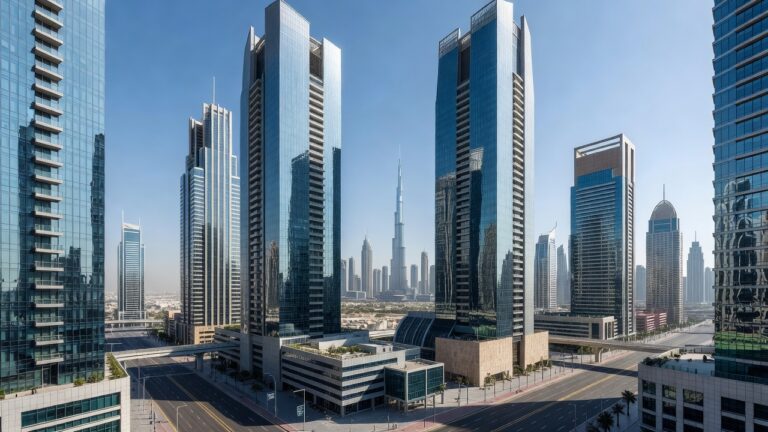
The UAE delivered robust results in the first three quarters of 2025, the report stated, with Dubai real estate transaction values advancing 28.3 percent year on year to AED554.1 billion and Abu Dhabi sales climbing 75.8 percent to AED58 billion while transaction numbers there increased 42.3 percent to 15,800. Rental yields in Dubai stood at 7.47 percent as of June 2025, exceeding comparable figures in Singapore, New York and London, according to the Markaz assessment. Industry data compiled by Knight Frank later showed Dubai’s full-year 2025 transaction value reached a record AED917 billion, a 20 percent increase that reflected sustained foreign and domestic demand. Markaz anticipated the UAE market could peak in the first half of 2026 before a period of moderation, with steady price and rental growth in Dubai and Abu Dhabi supported by strong underlying fundamentals.
GCC governments’ focus on economic diversification and large-scale projects has reinforced real estate as a central pillar, the Markaz report noted, creating opportunities across residential, commercial and industrial assets. Policy measures such as eased ownership rules and enhanced mortgage frameworks have broadened investor participation, particularly among expatriates and regional capital. Subsequent analyses, including those from CBRE, confirmed that global capability centres and multinational expansion continued to drive leasing and investment demand into 2026, aligning with the liquidity improvements highlighted in the earlier outlook.