 ع
ع


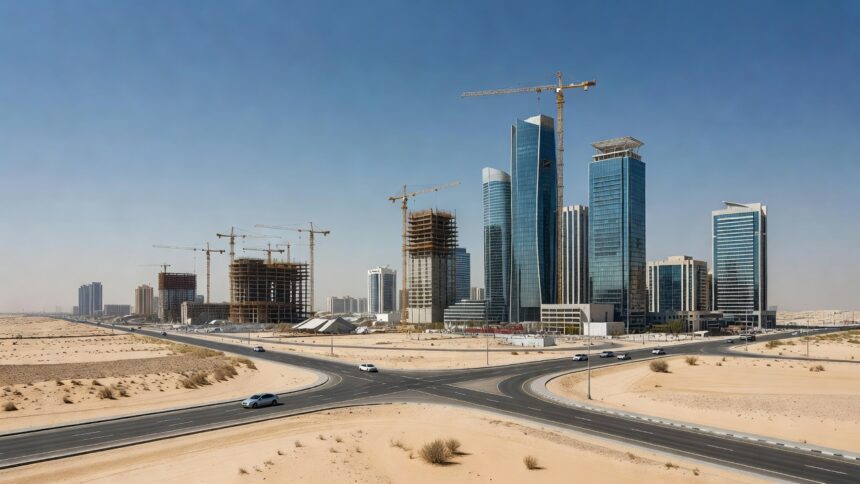
The contraction in the first three months of 2026 was driven mainly by sharp falls in Saudi Arabia and the United Arab Emirates, the bloc’s two largest project markets, according to a Kamco Investment report that cited MEED Projects data. Saudi contract awards plunged 51.1 percent to $11 billion from $22.5 billion a year earlier while the UAE saw an 18.5 percent decline to $29.2 billion from $35.8 billion. The report noted that these two markets together account for the bulk of GCC activity, amplifying the effect of any slowdown on the regional total.
Kuwait recorded a more than fivefold increase in awards to $8.1 billion from $1.5 billion in the same period of 2025, the Kamco report showed, while Oman and Qatar also posted growth that helped offset some of the larger economies’ weakness. The number of contracts awarded fell sharply as the quarter progressed, from 84 in January and 80 in February to only 25 in March, with monthly values dropping from $26 billion in February to $11.8 billion in the final month. Earlier Kamco Invest data indicated that the UAE had led the GCC with $88.2 billion in full-year project awards for 2025, underscoring how the Q1 2026 performance marked a reversal from recent strength.
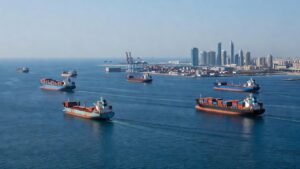
The Kamco Investment report attributed the slowdown to multiple effects of the US-Iran conflict, including supply chain delays from shipping disruptions in the Strait of Hormuz and reduced sentiment in real estate and tourism. “The war has already affected multiple aspects of life and business in GCC countries, including supply chain delays caused by shipping disruptions in the Strait of Hormuz, as well as dampening sentiment in key sectors such as real estate and tourism,” the report noted. It added that energy exports remain the primary revenue source for GCC economies, meaning any disruption to oil and gas production could significantly constrain governments’ ability to fund new projects.
Looking forward, the Kamco report anticipated that GCC project activity would stay subdued for the remainder of 2026 because of the broader economic fallout, with Kuwait, Qatar and Bahrain among those declaring force majeure on parts of their energy infrastructure. An Oxford Economics analysis downgraded its forecast for GCC real GDP growth by 1.8 percentage points to 2.6 percent for the year, citing lower oil production, exports, tourism and domestic demand. The International Monetary Fund similarly revised its 2026 projections, estimating contractions for several member states including 14.7 percent for Qatar.
Despite the near-term weakness, MEED Projects data cited in the Kamco report pointed to a robust pipeline of around $2 trillion in planned projects across the GCC, with Saudi Arabia representing nearly half and the UAE 27.5 percent. Construction is set to attract the largest share at 39.7 percent of the planned value, followed by transport at 16.3 percent and power at 15.7 percent. The report highlighted that most of these schemes remain at early stages, limiting their immediate contribution to award totals.
Projects in the design phase total $841.5 billion according to the MEED Projects figures, with a further $554.1 billion in the study stage and $220.4 billion under bid evaluation. The Kamco report observed that this pipeline could support a recovery once regional stability improves and fiscal pressures ease. Separate industry assessments, including from Mordor Intelligence, have projected the wider GCC construction market to expand from $332.64 billion in 2025 to $350.79 billion in 2026, though such forecasts assume a stabilisation in geopolitical conditions.