ع




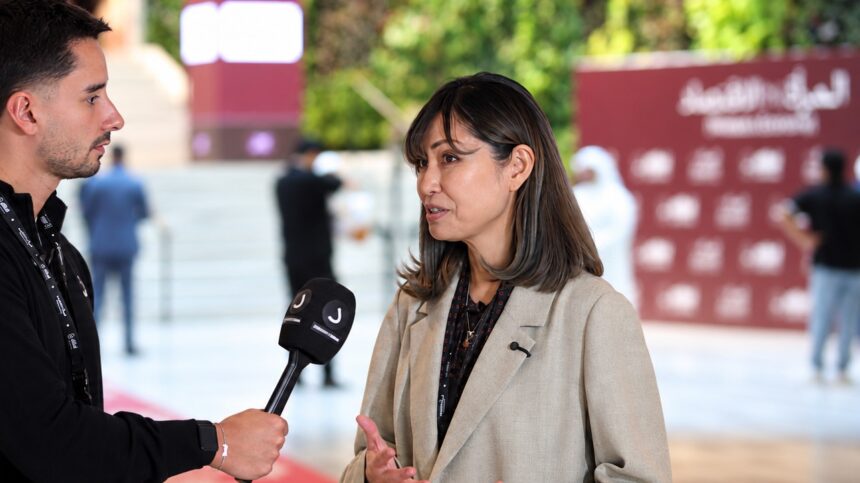
As employers prepare for a substantial shift in workplace skills, IKEA Kuwait’s Digital & IT Director tells Diwaniya Media why employee involvement deserves a central place in digital investment.
For a business investing in artificial intelligence, choosing the technology is only one decision. Another concerns the people who will use it: how they will learn, how their responsibilities will change and how they will become involved in the transition. Satoko Nozaki, Digital & IT Director at SYH IKEA Kuwait, places that organisational work at the centre of successful adoption.
Speaking to Diwaniya Media at the Women & the Economy conference in Kuwait, organised by Lei Wa Lakom, Nozaki said her experience across different cultures and organisations had reinforced the importance of change management. Implementing a system, she explained, can be more straightforward than helping people adopt it.
Her comments offer a useful perspective on the investment decisions surrounding AI. Alongside spending on systems and technical expertise, businesses face a continuing need to develop the capabilities of their existing employees. Global employer research suggests that this will involve a substantial share of the workforce over the coming years.
Looking beyond implementation
Asked about the challenges of introducing AI and changing established working practices, Nozaki described a pattern she had encountered internationally.
“I think the challenge is not isolated to Kuwait necessarily,” she said. “I have seen this pattern in many cultures, in many organizations, and that is, of course, the adoption of the change.”
Her response focused on the difference between having technology available and integrating it into the way people work. That distinction matters when a business assesses what a digital project requires. A system can be implemented on a technical level while employees are still learning how it relates to their responsibilities.
“And I think what I’ve learned very much is that change management, getting people involved in the change, is actually far more important than the technology itself.”
Nozaki’s emphasis was on participation. Employees are part of the transition, with their understanding and involvement shaping how a new tool becomes established within an organisation. Viewed through an investment lens, her argument broadens the work associated with a digital project beyond its installation and launch.
The scale of the learning requirement
The World Economic Forum’s Future of Jobs Report 2025 provides a measure of the workforce development employers anticipate. Based on responses from more than 1,000 employers across 55 economies, the report estimates that 59 out of every 100 workers would need training by 2030.
Within that group, employers expected 29 to be upskilled in their current roles and 19 to be trained and redeployed elsewhere within their organisations. These are global projections derived from the survey, covering several forces reshaping employment, rather than AI alone.
The findings also show the priority employers attach to developing existing staff: 85% of respondents planned to prioritise workforce upskilling over the 2025–2030 period.
For businesses considering how to allocate resources, these expectations place learning alongside other requirements of transformation. Some employees will need additional knowledge to continue in their existing positions, while others may use training to move into different responsibilities.
Nozaki’s comments address the organisational side of that process. Her focus on involving people suggests that learning and adoption should be considered together, with employees understanding how a change connects to the work they are expected to perform.
How one IKEA retailer is approaching AI learning
Within the wider IKEA retail network, workforce development has already become a reported area of AI activity. Ingka Group’s FY24 reporting stated that more than 4,000 co-workers had participated in AI training, while its AI literacy awareness resources had received more than 54,000 views.
The figures concern Ingka Group, a separate IKEA retailer from the Al-Homaizi business in Kuwait. They offer an international example of employee learning accompanying technology development, rather than a measure of IKEA Kuwait’s activity.
In an earlier announcement about its AI training initiative, Ingka described an approach intended to extend AI literacy across its organisation. Its subsequent reporting provides evidence of participation, although training totals alone do not establish the financial return from that activity.
That distinction is relevant to the investment discussion. The number of people completing training measures one stage of a programme. Nozaki’s emphasis on adoption directs attention to what happens as employees begin applying technology in their work.
She did not give a return-on-investment figure or announce a new local programme during the interview. Her contribution was a practical observation about the conditions businesses need to consider when introducing change.
A responsibility shared across the business
Nozaki also argued that technological knowledge is becoming relevant across business functions and government, extending the learning requirement beyond specialist IT teams.
“So leaning into the technology, learning the technology has become increasingly important whether or not you work for technology teams.”
For employers, that broadens the group of people involved in a digital transition. A project may originate within a technology department, but its day-to-day use can involve employees whose expertise lies elsewhere. Their professional knowledge remains part of the business, while their ability to work with changing systems becomes an additional consideration.
For young people, Nozaki sees familiarity with digital technology as a foundation on which to build. She encouraged the next generation to develop the skills they already possess, describing their experience of growing up with technology as an advantage.
The two parts of her message are closely connected. Individuals have a role in continuing to learn, while organisations have a role in involving them as working practices evolve.
For those overseeing technology investment, this brings workforce development into the same conversation as implementation. Nozaki’s comments leave a practical question for the period after a system goes live: what support will employees receive as they turn access to the technology into regular use?