
 ع
ع




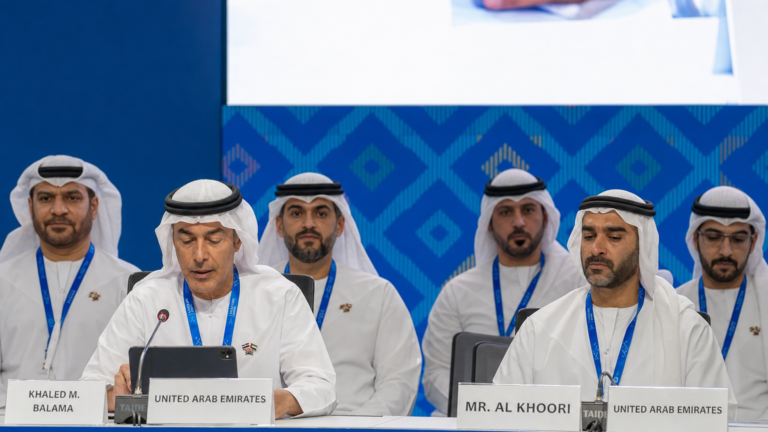
The Emirates News Agency reported that His Highness Sheikh Mansour bin Zayed Al Nahyan, Vice President, Deputy Prime Minister and Chairman of the Presidential Court, chaired the Financial Stability Council Board meeting. Key attendees included Mohamed bin Hadi Al Hussaini, Minister of State for Financial Affairs, and Khaled Mohamed Balama, Governor of the Central Bank of the UAE. The gathering also drew Mohamed Ali Al Shorafa, Chairman of the UAE Capital Market Authority, along with the chairmen of the Abu Dhabi Global Market and the Dubai Financial Services Authority as well as the Central Bank assistant governor for monetary policy and financial stability.
According to the Emirates News Agency the Council reviewed implementation of decisions and recommendations from its previous meeting. Members received briefings on measures taken amid current developments and on the progress achieved by its various working groups. These discussions formed part of continuous efforts to improve preparedness across the financial system and to safeguard its overall stability.
The Emirates News Agency stated that the Council examined its Artificial Intelligence Plan during the session. The plan focuses on using advanced technologies to support monitoring and analysis of risks while helping to anticipate future trends that could affect stability. Officials noted that the initiative would aid decision-making processes and raise operational efficiency within the Council’s functions.
WAM added that the Council approved a proposal to organise the First Financial Stability Conference. The event is designed to create a national platform for regulatory authorities, financial institutions, industry experts and policymakers to examine key developments and to exchange knowledge along with best practices. Such a gathering aims to contribute to the resilience and long-term sustainability of the UAE financial sector.
The Council also discussed multiple topics tied to its core mandate as part of sustained work to reinforce financial stability nationwide, the Emirates News Agency reported. Sheikh Mansour bin Zayed Al Nahyan emphasised the importance of continued cooperation and coordination among all members. Mansour stated that coordination is key to strengthen resilience of the financial system while enabling it to keep pace with economic and financial developments and to back sustainable growth across the UAE.
A Central Bank of the UAE assessment found the national financial system maintained robust conditions with strong capital and liquidity buffers in the banking sector. Central Bank of the UAE figures show real GDP growth reached approximately 5.6 percent in 2025 driven largely by expansion in non-oil sectors. The bank’s projections place GDP growth at 4.4 percent for 2025 and 5.4 percent in 2026 reflecting positive outlooks despite global risks.
Previous Central Bank of the UAE reports indicated the Financial Stability Council became operational in 2024 to improve coordination among stakeholders on systemic risks. The body has since supported timely policy responses and risk oversight across regulatory entities. Such efforts have contributed to the overall stability assessment contained in the bank’s annual reviews.