ع




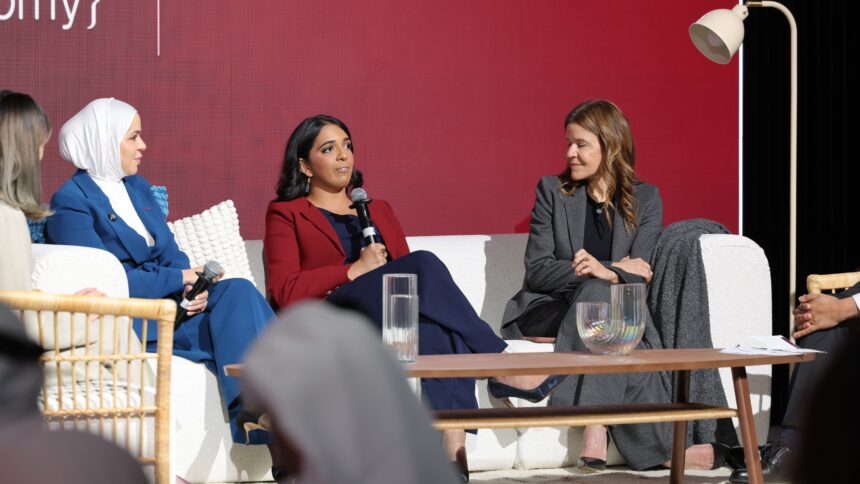
Kriti Gupta tells Diwaniya Media that Kuwait’s mix of family wealth and entrepreneurs makes it a distinctive market for J.P. Morgan, while highlighting the women helping shape its business community.
Kuwait’s appeal to J.P. Morgan extends across established family wealth and entrepreneurs building businesses in different industries, according to Kriti Gupta, an executive director and global investment strategist at J.P. Morgan Private Bank.
Speaking to Diwaniya Media at the Women & the Economy conference, Lei Wa Lakom, Gupta described Kuwait as a crucial market for the bank and pointed to the breadth of its local client relationships as a distinguishing feature.
“Kuwait is a crucial market for JP Morgan,” she said. “We have plenty of clients who are based here.”
Visiting Kuwait from New York for the first time, Gupta connected that commercial perspective with what she had encountered at the conference: women holding positions of authority across banking, digital innovation and other areas of business, brought together to discuss the economy from different professional perspectives.
A client base spanning family wealth and entrepreneurship
For Gupta, the significance of Kuwait’s market lies partly in the different backgrounds of the people participating in it.
“One of the really key takeaways of the way the bank thinks about Kuwait broadly is that it’s one of our most diversified client bases,” she said.
She described a spectrum running from traditional family wealth to female and male entrepreneurs operating across industries. It was this combination, rather than a single category of investor, that she said stood out in Kuwait relative to some other regional markets where the bank operates.
Her comments offer a view of Kuwait through the relationships of an international wealth manager. They are an assessment of the bank’s own client base, rather than a statistical ranking of the country’s investors, but they identify the range of people involved in its investment conversations.
That distinction matters. A country’s importance to a financial institution can be discussed through the amount of money it manages, the number of clients it serves or the variety of financial decisions those clients bring. Gupta’s emphasis was on the third: established wealth and entrepreneurial activity appearing within the same market.
The interview did not set out a new investment commitment or expansion timetable. Instead, it explained why Kuwait already matters to the bank and which characteristics of its client relationships Gupta considers distinctive.
Women as business leaders and financial decision-makers
The conference gave that description a more immediate setting. Asked what had impressed her most, Gupta focused on the concentration of women in senior roles and the opportunity to hear them exchange perspectives across industries.
“This event is incredible in that there are so many women in positions of authority,” she said.
Her observations moved between two connected roles. Women were present as leaders making decisions within organisations, and female entrepreneurs also formed part of the client base she described when discussing Kuwait’s importance to J.P. Morgan.
In that account, women’s economic participation encompasses both professional responsibility and business ownership. A discussion about leadership therefore also becomes a discussion about who builds companies, makes investment decisions and participates in relationships with financial institutions.
Gupta highlighted the value of bringing these different perspectives into the same room. Her own experience in investment strategy sat alongside those of people working in digital innovation and local banking, allowing the conversation to move across professional boundaries.
That was the feature she returned to when assessing the event. Its value, in her telling, came from the experience and responsibilities of the people attending, and from their ability to compare what was changing in their respective industries.
The wider economic setting
Gupta’s account sits within a broader discussion about Kuwait’s non-oil economy and the financial activity supporting it.
In its 2025 Article IV consultation, published in February 2026, the International Monetary Fund reported that Kuwait’s non-oil economy expanded by 3.1 per cent year on year in the second quarter of 2025. It also described the financial system as stable and prudently managed.
Those national findings do not measure the composition of J.P. Morgan’s clients. They provide a separate economic backdrop to Gupta’s observations about the variety of businesses and investors with which the bank has relationships.
Her role places her at the point where global developments are translated into investment discussions. According to her official J.P. Morgan biography, she develops and communicates the firm’s economic views and investment strategies, including assessing how international developments affect portfolios.
That helps explain why her comments about Kuwait focused on the people making financial decisions. Understanding a market, from that perspective, involves understanding the different experiences and priorities represented within its investor base.
Preparing for careers that will keep changing
Alongside her assessment of Kuwait, Gupta offered a direct message to women beginning their careers: develop a broad range of skills.
“Learn as many skills as possible,” she said. “Regardless of what your industry is, change is happening faster and faster.”
She linked that advice to the possibility of changing careers more than once. Learning, in her account, gives people greater scope to move between roles as industries evolve.
The World Economic Forum’s Future of Jobs Report 2025 offers a wider context for that message. Employers surveyed expected 39 per cent of workers’ existing skills to change or become outdated between 2025 and 2030. That is a global employer outlook, rather than a Kuwait-specific forecast.
For Gupta, the practical response begins with the individual’s capacity to keep learning. Her first visit brought together two sides of that argument: the established business leaders and entrepreneurs she encountered in Kuwait, and the women considering how to build careers that may take several different forms.
“So, the more skills you learn means that you can change careers maybe multiple times in a lifetime,” she said.